

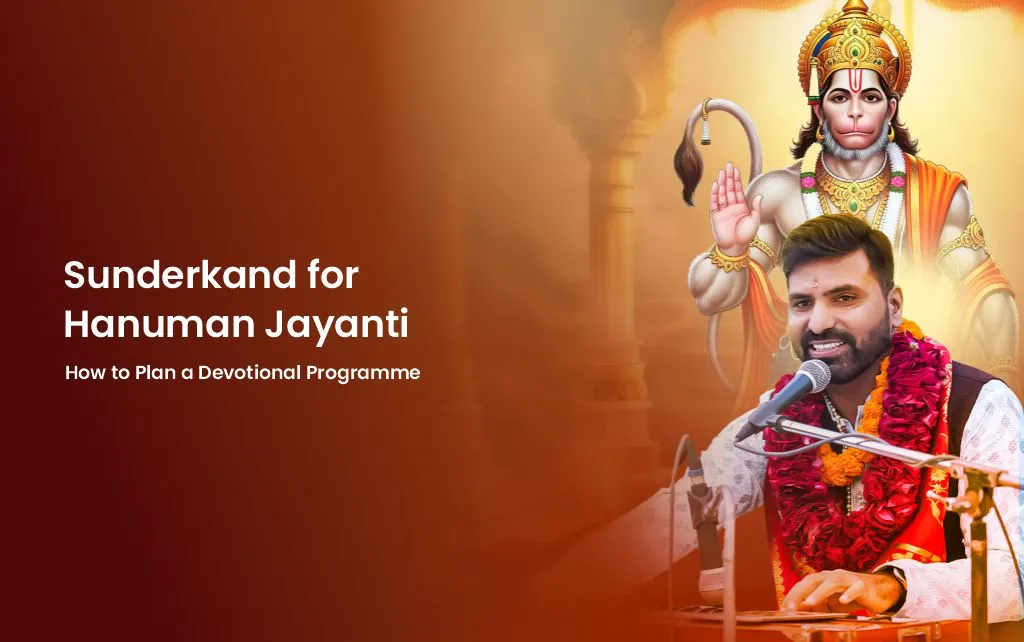
Sunderkand for Hanuman Jayanti has become one of the most common ways for families, temples, and communities in India to mark the occasion. Sunderkand is a chapter of the Ramcharitmanas that centres entirely on Hanuman, which makes it a natural choice for Hanuman Jayanti celebrations. But a Sunderkand paath programme for Hanuman Jayanti involves more than choosing a date and inviting guests. It needs a clear plan for the recitation or singing, the venue, the schedule, the prasad, and the people who will help run the event.
This article walks through what Sunderkand means in this context, why it fits Hanuman Jayanti so well, and how to plan every part of the programme step by step, from the paath itself to seating, sound, and the singer who leads it.
Sunderkand is meaningful for Hanuman Jayanti because the entire chapter is built around Hanuman’s courage, devotion, and service to Lord Ram.
Sunderkand is the fifth chapter (kand) of the Ramcharitmanas, written by Goswami Tulsidas. It narrates Hanuman’s journey across the ocean to Lanka, his search for Sita, and his return with news of her whereabouts. Unlike other chapters of the epic that follow several characters, Sunderkand keeps its focus almost entirely on Hanuman. That is one reason many families and temples treat it as the natural devotional text for Hanuman Jayanti.
The chapter also reflects qualities devotees associate with Hanuman: humility, strength used in service rather than for personal gain, and unwavering focus on a task. Reading or listening to Sunderkand as a group allows everyone present to reflect on these qualities together rather than simply hearing a story.
Group participation adds another layer of value. When a family, a residential society, or a temple committee organises a Sunderkand programme, the event becomes a shared act of devotion rather than an individual one. People take turns reciting verses, join in the singing, or simply sit and listen with attention. Many devotees regard this collective participation as central to the experience, though the emphasis and format can differ from one household or community to another.
It is worth being clear about intent from the start. A Sunderkand programme works best when the focus stays on devotion and shared reflection, not purely on entertainment or spectacle. Music and singing can support that devotional atmosphere, but they should not replace it.
Planning a Sunderkand programme for Hanuman Jayanti works best as a sequence of decisions, starting with purpose and format, and ending with a final check on the day before the event.
A structured approach prevents last-minute confusion and helps everyone involved, from family members to volunteers, know what to expect.
Working through this list in order, rather than jumping between tasks, keeps the planning manageable even for first-time organisers.
A typical Hanuman Jayanti Sunderkand programme includes an opening prayer, the Sunderkand paath or singing, Hanuman and Ram bhajans, an aarti, and prasad distribution, though the exact order and elements vary by family and tradition.
Common elements include:
There is no single mandatory format that every household or temple must follow. A family gathering at home may keep things simple, with a short paath and an aarti, while a temple or residential society event may build a longer programme around musical Sunderkand and multiple bhajans. Organisers should choose elements that suit their tradition, their guests, and the time they have available, rather than trying to include everything on this list.
Choosing a Sunderkand singer for Hanuman Jayanti comes down to checking their familiarity with the text, their ability to hold a devotional atmosphere, and their reliability around logistics like sound, timing, and communication.
A few practical checks help narrow down the choice:
Many organisers search online for the best sunderkand singer in india before finalising their choice, and it helps to look at video samples, listen to pronunciation and musical style, and speak directly with the singer about the specific Hanuman Jayanti programme being planned. A short conversation before booking usually reveals whether the singer’s style and experience match what the event needs.
Venue requirements for a Sunderkand programme scale with the size of the gathering, ranging from a simple living-room setup for a family event to full sound and seating arrangements for a temple or community hall.
Consider the following depending on where the programme is held:
Practical arrangements to plan for, regardless of venue:
A home gathering for twenty people does not need the same level of planning as a residential society event for two hundred, but working through this checklist at the appropriate scale avoids last-minute surprises.
A Sunderkand programme schedule for Hanuman Jayanti typically moves from guest arrival to an opening prayer, the paath or singing, bhajans, aarti, and prasad, with total duration depending on the format chosen.
A sample structure that organisers can adapt:
| Segment | Approximate Focus |
| Guest arrival and seating | Welcome attendees, settle seating |
| Opening prayer | Invocation, Ganesh Vandana if followed |
| Sunderkand paath or singing | Main recitation, sung or read |
| Hanuman bhajans | Devotional singing between or after the paath |
| Aarti | Closing worship |
| Prasad distribution | Refreshments and prasad for all attendees |
| Closing | Vote of thanks, informal conversation |
These timings are not religious requirements. The total duration depends on the chosen format, the pace of recitation, how many bhajans are included, how much the audience participates, and how the organiser structures the overall event. A home programme might run for ninety minutes, while a temple or community event with extended singing could run for three hours or more. Deciding on the approximate duration early helps when communicating timing to guests.
Prasad and bhajan planning for a Hanuman Jayanti Sunderkand programme should match the size of the gathering and the devotional tone of the event, without treating any specific offering as compulsory.
A few areas deserve attention:
Traditional offerings such as specific sweets, flowers, or items connected to Hanuman worship vary by family, region, and personal custom. These are common devotional practices in many households, not universal requirements, and organisers should feel free to follow what is meaningful to their own family or community rather than assuming one format applies everywhere.
An experienced Sunderkand singer contributes structure and continuity to a Hanuman Jayanti programme, guiding the pace of the recitation, leading bhajans, and helping the audience stay engaged through the devotional flow of the event.
Specific ways a skilled singer supports the programme include:
Because Hanuman Jayanti sees a large number of bookings on the same day, many organisers begin their search by looking up a famous sunderkand singer to shortlist a few names before checking availability and style. Popularity alone does not guarantee the right fit for every event, so it is worth pairing that initial research with a direct conversation about the specific programme, its format, and its audience.
Most problems in a Sunderkand programme for Hanuman Jayanti come from late decisions, particularly around booking the singer, planning sound, and confirming numbers, rather than from the devotional content itself.
Avoid these common mistakes:
Working through the planning checklist earlier in this article, well ahead of the event date, addresses most of these issues before they arise.
When shortlisting a performer for a Sunderkand programme, it helps to look for classical musical training, direct experience with Sunderkand specifically rather than devotional music in general, and a repertoire that fits both traditional paath and musical singing formats.
Pushkar Kandpal, born in Uttarakhand, trained in Hindustani classical music under Ustad Ghulam Murtuza Khan, and his primary offering is Musical Sunderkand Paath, presented with live orchestral accompaniment alongside expressive narration. His work also extends to Ram Bhakti and Hanuman bhajans, Sufi and devotional evenings, and live music concerts for temples and religious gatherings. According to his official website, he has performed Musical Sunderkand Path across more than 500 live programmes in India, and his devotional recordings have been released through associations with T-Series, Sanskar Music, and Ambey Bhakti, in addition to being available on platforms such as Spotify and YouTube Music. His work has also received coverage from outlets including ABP News, News24, ABP Live, and Dainik Jagran.
Pushkar Kandpal offers Sunderkand programmes for homes, temples, and devotional events, with services currently listed across Delhi, Noida, Gurgaon, Ghaziabad, Faridabad, Greater Noida, Mumbai, and Bangalore. For readers evaluating options for their Hanuman Jayanti celebration, reviewing sample performances and speaking directly with the singer about the specific format, whether a traditional paath, a musical Sunderkand, or a combined programme with bhajans, remains the most reliable way to confirm fit before booking.
Different organisers have different needs, and the right format depends on a few practical factors.
When deciding on format, weigh the number of expected participants, the venue available, how much time can realistically be allocated, the budget for singer fees and prasad, whether the family or temple follows a specific religious format, singer availability on the chosen date, sound requirements for the space, how many volunteers are available, prasad arrangements, and what the audience is likely to expect based on past years’ celebrations. Matching the programme to these realities, rather than copying a format used elsewhere, leads to a smoother event.
Sunderkand for Hanuman Jayanti works well as a devotional programme because the text itself centres on Hanuman, and because a shared recitation gives families, temples, and communities a meaningful way to mark the occasion together. Getting the programme right takes more than picking a date. It means thinking through the venue, the schedule, the singer, the sound arrangements, and the prasad, well before the day arrives.
Whether the plan is a quiet home recitation or a larger community event with musical Sunderkand and bhajans, working through each of these decisions early gives the programme its best chance of running smoothly and staying focused on devotion. For those looking for support with the singing portion of their Hanuman Jayanti programme, Pushkar Kandpal’s Musical Sunderkand Paath offers one option worth exploring, alongside Ram Bhakti and Hanuman bhajan performances suited to home, temple, and community settings. Review the format, confirm availability for your date, and plan the rest of the arrangements around a clear, well-communicated schedule.
1. What is the significance of Sunderkand on Hanuman Jayanti? Sunderkand narrates Hanuman’s journey to Lanka and his devotion to Lord Ram, which makes it a fitting text for Hanuman Jayanti. Many devotees choose to recite or sing it as a way to reflect on the qualities associated with Hanuman on his birth anniversary.
2. How do you plan a Sunderkand programme for Hanuman Jayanti? Start by deciding the format and date, then finalise the venue, estimate attendance, arrange the singer or paath, plan seating and sound, prepare prasad, assign volunteers, confirm the schedule, and communicate details to guests before completing a final check.
3. What should be included in a Hanuman Jayanti Sunderkand programme? Most programmes include an opening prayer, the Sunderkand paath or singing, Hanuman and Ram bhajans, an aarti, and prasad distribution, though the exact elements and order vary by family, temple, and tradition.
4. How long does a Sunderkand programme usually take? Duration depends on the format. A simple home paath may take ninety minutes, while a larger programme with musical singing and multiple bhajans can run for two to three hours or longer.
5. How do I choose a Sunderkand singer for Hanuman Jayanti? Look at familiarity with Sunderkand specifically, vocal clarity, experience with group programmes, sound requirements, and availability on your date. Watching sample videos and speaking with the singer directly about your programme format helps confirm the right fit.
6. Can Sunderkand be organised at home for Hanuman Jayanti? Yes. A home Sunderkand programme typically needs a clean space for the devotional setup, seating for guests, basic sound arrangements if the group is larger than a few families, and prasad for those attending.
7. What arrangements are needed for a Sunderkand paath programme? Key arrangements include the venue, seating, sound and microphones, lighting, prasad, drinking water, and volunteers to manage guest coordination and cleanliness before and after the event.
8. What should I confirm with a Sunderkand singer before booking? Confirm availability on the exact date, the expected programme format and duration, sound and microphone needs, venue address and timing, and any specific bhajans or customs you want included.