

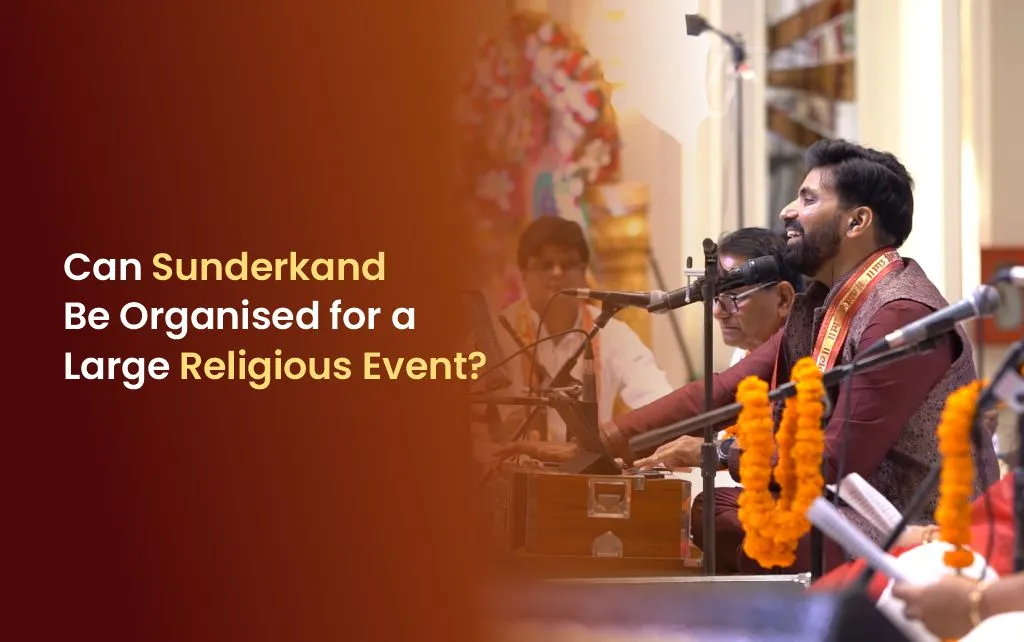
Temple committees, community groups, and families planning a big devotional gathering often ask the same question before they book anything: can Sunderkand actually work when hundreds of people are involved, not just a small home gathering? It is a fair question. Sunderkand is traditionally recited in intimate settings, so it is natural to wonder if the same devotional depth survives when the audience grows, and the venue changes from a living room to a hall or temple grounds.
This article answers that question directly and walks you through what actually goes into planning a Sunderkand for a large religious event, from choosing the right format to managing sound, seating, and timing. Whether you are a temple committee, a residential welfare association, a corporate CSR team, or a family organising a community-wide programme, you will find practical guidance here that you can use immediately.
Yes, Sunderkand can be organised for a large religious event. It is one of the most flexible chapters of the Ramcharitmanas to present in a group setting because it is structured as a continuous narrative recitation built around chaupais and dohas, which naturally lends itself to being sung, followed, and listened to by a large gathering without losing its devotional character.
A large Sunderkand event works when three things come together: a presentation style suited to a bigger audience, sound and seating arrangements that let everyone hear and see clearly, and coordination that keeps the programme moving without feeling rushed. When these three elements are planned properly, a Sunderkand programme scales up well, whether it is held in a temple courtyard, a community hall, a banquet space, or an open ground during a festival.
The difference between a small home Sunderkand and a large religious gathering is not the content of the paath itself. It is the planning around it. Once organisers understand what needs to be arranged, the event becomes manageable and often more impactful, since a larger gathering means more people experiencing the recitation together.
Sunderkand is well suited to group settings for reasons rooted in how it is structured and how devotees traditionally engage with it.
Sunderkand tells a complete story within itself, covering Hanuman Ji’s journey to Lanka, his meeting with Sita Mata, and his return with news of hope. Because it follows a clear narrative arc, listeners can stay engaged even in a large hall, unlike scattered bhajans or standalone shlokas that do not build toward anything. This makes it a natural fit for a large Sunderkand event where audience attention needs to be held for an extended period.
Group recitation of Sunderkand is already common in Hindu households and temples, often with multiple voices joining in for certain chaupais. This tradition of shared participation transfers naturally to a larger religious gathering, where audience members can follow along, respond to invocations, and join collectively during well-known verses such as the Hanuman Chalisa if it is included at the start or end of the programme.
When presented with harmonium, dholak, and vocal support, Sunderkand gains a rhythmic structure that helps a large audience follow along more easily than a plain-spoken recitation would. This is where Musical Sunderkand becomes especially relevant for big gatherings, a point covered in more detail later in this article.
A Sunderkand programme can be organised as a standalone religious function, as part of a larger festival such as Hanuman Jayanti, as a temple’s weekly or monthly devotional event, or as a community gathering tied to an auspicious occasion. This flexibility is one reason Sunderkand for religious gathering formats keep growing in popularity across temples and residential communities.
Planning a large Sunderkand event is largely a matter of good event management applied to a devotional context. Here is how organisers typically approach it.
Decide early whether this is a one-time programme, an annual tradition, or a recurring monthly event. This decision affects venue booking, budget, and how far in advance you need to invite the Sunderkand Singer and other participants. Also decide whether you want a traditional spoken paath, a fully Musical Sunderkand, or a combination where certain sections are sung and others recited.
Large religious gatherings need a venue that can comfortably seat the expected number of attendees while leaving space for a stage or altar area, sound equipment, and movement for volunteers. Temple halls, community centres, banquet halls, school or society grounds, and open temple courtyards are all commonly used for a Sunderkand for a temple event or a Sunderkand for a community event.
Work backward from the event date. Confirm the Sunderkand Singer and any accompanying musicians first, since their availability often decides the final date. Then lock the venue, arrange sound and seating, finalise invitations, and assign volunteer responsibilities. A timeline of four to six weeks gives most organisers enough room to handle each step without last-minute pressure.
Large events run smoothly when specific people are responsible for specific tasks: one team for guest reception and seating, one for sound and stage management, one for prasad and bhog distribution, and one point of contact who coordinates directly with the Sunderkand Singer on programme flow. This kind of Sunderkand event planning removes ambiguity on the day of the event.
Yes, Musical Sunderkand is particularly well suited to large audiences, and in many cases it works better than a purely spoken recitation once the crowd size grows.
In a small home setting, a quiet spoken recitation can hold everyone’s attention because the group is close together. In a large hall or open ground, sound naturally has to travel further, and a musical structure with harmonium, dholak, and a trained voice carries better across a bigger space while keeping listeners engaged through rhythm and melody. This is one of the main reasons families and committees now search specifically for Musical Sunderkand when planning anything beyond a small gathering.
A well-presented Musical Sunderkand does not turn the event into a performance. The music supports the text rather than overshadowing it. A responsible Sunderkand Singer keeps the emphasis on correct pronunciation, appropriate pacing, and the meaning of the chaupais, using the musical elements to aid comprehension and participation rather than for spectacle. This distinction matters, especially for temple committees who want a devotional programme rather than a concert-style event.
Musical Sunderkand often includes moments where the audience can join in, particularly during repeated refrains or the closing Hanuman Chalisa and aarti. In a large gathering, this shared participation strengthens the collective devotional experience in a way that a purely one-directional recitation cannot always achieve.
Pushkar Kandpal presents Musical Sunderkand with harmonium and vocal accompaniment, structured to work for both intimate home settings and larger devotional gatherings, keeping the presentation rooted in the text while making it accessible to a bigger audience.
Choosing the right Sunderkand Singer is one of the most important decisions in planning a large religious event, since the entire programme’s tone depends on this presentation.
The most basic requirement is accurate pronunciation and correct rendering of the chaupais and dohas. For a large gathering, clarity matters even more, since any mispronunciation or unclear diction becomes obvious across a bigger sound system and audience.
A singer experienced with big gatherings understands how to pace the recitation so it neither drags nor feels rushed. This includes knowing when to slow down for reflection during key moments, such as Hanuman Ji’s meeting with Sita Mata, and when to build momentum, such as during the burning of Lanka.
For a large event, the Sunderkand Singer needs to coordinate with the venue team, sound engineers, and event coordinators, not just perform in isolation. Ask in advance how the singer typically works with organisers on programme timing, sound checks, and any changes needed on the day.
If you are planning a Musical Sunderkand, confirm whether the singer works with a harmonium, dholak, or chorus support, and whether that arrangement suits your venue size and audience.
Pushkar Kandpal is a classically trained devotional singer from Uttarakhand, based in the Delhi NCR region, known for presenting the complete Sunderkand Singer experience in a style that keeps large gatherings engaged from start to finish while staying true to the text.
Here is a practical checklist that covers the essentials for organising a Sunderkand for a large religious event.
Pushkar Kandpal is a classically trained devotional singer, originally from Uttarakhand and now based in the Delhi NCR region, known for his renditions of Sunderkand Path and Musical Sunderkand. His work focuses specifically on presenting the complete Sunderkand in a way that stays close to the original text while remaining accessible to listeners across age groups.
For organisers planning a Sunderkand programme, whether for a family gathering, a temple event, a residential community, or a larger religious function, Pushkar Kandpal offers presentations that can be discussed and structured according to the event’s format, whether that is a traditional spoken paath or a Musical Sunderkand with harmonium accompaniment. Details on formats, availability, and how to plan the programme around your event can be discussed directly by reaching out through the Sunderkand page or the contact page on the website.
If your event is location-specific, information on Sunderkand programmes across Delhi, Noida, Gurgaon, Ghaziabad, Faridabad, Greater Noida, Mumbai, and Bangalore is available through the respective city pages linked on the website, making it easier for organisers in these regions to plan and coordinate.
Before you finalise your Sunderkand programme, confirm the following:
Going through this list a week before the event gives organisers enough time to fix gaps without last-minute stress.
Sunderkand can absolutely be organised for a large religious event, and it works well when the planning matches the scale of the gathering. The recitation’s narrative structure, its tradition of collective participation, and the option to present it as a Musical Sunderkand all make it adaptable to halls, temple grounds, and community spaces, not just intimate home settings. What decides whether the event feels devotional and well-organised, rather than chaotic, comes down to venue planning, sound quality, seating management, and choosing a Sunderkand Singer who understands how to hold a large audience’s attention while keeping the programme rooted in tradition.
If you are planning a Sunderkand programme for a temple, community, or family gathering and want a presentation that is both authentic and suited to a larger audience, reach out to Pushkar Kandpal through the Sunderkand page to discuss your event and explore how a Musical Sunderkand or traditional Sunderkand Paath can be structured for your gathering.
Comments are closed