

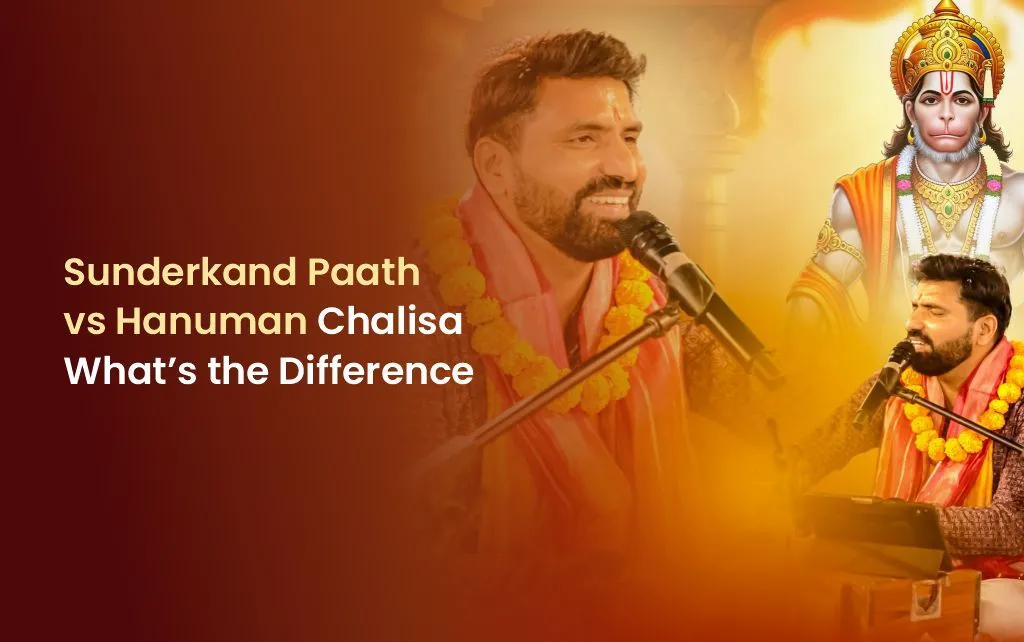
Sunderkand Paath and Hanuman Chalisa are both closely connected to the worship of Lord Hanuman, but they are not the same thing. In the comparison of Sunderkand Paath vs Hanuman Chalisa, the core difference is this: Hanuman Chalisa is a short, 40-verse devotional hymn that praises Lord Hanuman’s qualities, while Sunderkand is a much longer section of the Ramcharitmanas that narrates the story of Hanuman’s journey to Lanka, his search for Sita, and his return with news for Lord Rama. This article compares their origin, purpose, length, structure, and traditional use, so you can understand which one fits your devotional routine, or whether you can include both.
The main difference between Sunderkand and Hanuman Chalisa comes down to what each text actually is.
Hanuman Chalisa is a devotional hymn made up of 40 chaupais (verses), composed as a prayer of praise. It focuses on Hanuman Ji’s strength, wisdom, humility, and unwavering service to Lord Rama.
Sunderkand, on the other hand, is one of the seven kands (sections) of the Ramcharitmanas, the epic composed by Goswami Tulsidas. It is a narrative section that tells the story of Hanuman’s flight across the ocean, his search for Sita in Lanka, his meeting with her, his encounter with Ravana’s forces, and his return to Lord Rama with news of Sita’s whereabouts.
In short:
Their structure, length, and devotional purpose are different, even though both are rooted in Hanuman bhakti.
|
Aspect |
Sunderkand Paath |
Hanuman Chalisa |
| Source | A section (kand) of the Ramcharitmanas | A separate devotional composition by Tulsidas |
| Nature | Narrative storytelling | Devotional hymn of praise |
| Main focus | Hanuman’s journey, search for Sita, and actions in Lanka | Hanuman’s qualities, strength, and devotion to Rama |
| Length | Longer, several hundred verses (chaupais and dohas) | Shorter, 40 chaupais plus opening and closing verses |
| Typical reading time | Around 45 minutes to over an hour, depending on pace | A few minutes, generally 5 to 10 minutes |
| Format | Continuous narrative recited as a paath | Fixed set of 40 verses |
| Common use | Special occasions, dedicated devotional sittings | Daily or regular personal prayer |
| Recitation style | Often performed by a singer or group, sometimes with musical accompaniment | Usually recited individually, sometimes in groups |
Sunderkand literally means the “beautiful chapter” or “chapter of beauty.” It is the fifth kand of the Ramcharitmanas, the Awadhi-language retelling of the Ramayana written by Goswami Tulsidas in the sixteenth century.
The Sunderkand section narrates a pivotal part of the Rama-Sita story. After Sita is abducted and taken to Lanka, Hanuman is sent to find her. Sunderkand describes:
Reciting this section as a devotional practice is commonly called Sunderkand Paath. The word “paath” itself simply means a recitation or reading of a religious text.
Within Hindu devotional tradition, Sunderkand holds an important place because Hanuman’s actions in this section are seen as an example of courage, loyalty, humility, and complete devotion to Lord Rama. Devotees traditionally regard the events narrated in Sunderkand as an illustration of what steady faith and selfless service can look like, rather than treating every detail as a historical record in the modern sense. What the text narrates and what devotees take from it as a moral or spiritual lesson are two related but distinct things, and different communities may emphasise different aspects of the story.
Hanuman Chalisa is a devotional composition attributed to Goswami Tulsidas, the same poet-saint who wrote the Ramcharitmanas. The word “chalisa” comes from “chalis,” meaning forty, referring to the 40 chaupais that make up the main body of the hymn, bookended by introductory and closing verses.
Unlike Sunderkand, Hanuman Chalisa does not tell a continuous story. Instead, it is structured as a series of praises and invocations addressed directly to Hanuman Ji. Its verses describe:
Because it is short and rhythmic, Hanuman Chalisa meaning and Hanuman Chalisa verses are widely known even among people with limited familiarity with Sanskrit or Awadhi vocabulary. Many households recite it as part of a regular morning or evening prayer, and it is often the first devotional text people learn as children.
It’s worth being careful here: while Hanuman Chalisa is widely recited with the hope of divine blessing and protection, it does not guarantee specific outcomes in a person’s life. In devotional tradition, it is understood as an expression of faith and remembrance rather than a mechanism with assured results.
To directly compare Sunderkand vs Hanuman Chalisa across the factors that matter most to someone deciding between the two:
What is the main difference between Sunderkand and Hanuman Chalisa? Sunderkand is a long narrative section of the Ramcharitmanas describing Hanuman’s journey to Lanka, while Hanuman Chalisa is a short 40-verse hymn praising Hanuman’s virtues. One tells a story; the other offers praise.
Is Sunderkand longer than Hanuman Chalisa? Yes. Sunderkand contains several hundred verses and takes considerably longer to recite than the 40 chaupais of Hanuman Chalisa.
Is Hanuman Chalisa part of Sunderkand? No. Hanuman Chalisa is a separate composition. It is not included within the Sunderkand section of the Ramcharitmanas, though both are associated with Hanuman devotion and both are attributed to Tulsidas.
Sunderkand Paath is traditionally undertaken as an act of devotion connected to specific themes drawn from the narrative itself. Many devotees see Hanuman’s conduct in the Lanka episode as representing:
In Hindu devotional practice, reciting or listening to Sunderkand is commonly associated with seeking strength during difficult periods, and with cultivating patience and resolve. Many people regard it as a way to draw on Hanuman’s example when facing personal challenges. These are matters of faith and long-standing tradition rather than claims that can be verified as guaranteed outcomes, and it would be inaccurate to present them otherwise. Sunderkand does not promise to remove specific problems, and no responsible description of the practice should suggest that it does.
Hanuman Chalisa benefits are usually described in terms of devotional and personal significance rather than measurable results. Commonly associated themes include:
These are traditional and devotional associations, not scientifically established claims. Hanuman Chalisa should not be presented as a treatment for medical conditions, a guarantee of financial improvement, or a solution to specific life problems. Its place in daily worship comes from its role as a consistent devotional practice rather than from any promised result.
Because the two differ so much in length and format, they tend to suit different situations.
Sunderkand Paath at home or in a group setting is commonly arranged for:
Hanuman Chalisa at home fits more easily into:
It’s worth noting that devotional practices can vary between families, regions, and communities. Some households recite Hanuman Chalisa every single day, while others reserve more elaborate Sunderkand recitations for particular months or festivals. There is no single rule that applies to everyone.
Yes. There is nothing in either tradition that requires choosing one over the other. Many devotees include both in their overall devotional routine, simply because they serve different purposes.
Hanuman Chalisa works well as a short, regular prayer that can be repeated daily without much time investment. Sunderkand, because of its length and narrative depth, is better suited to occasions when a devotee wants to set aside dedicated time for a fuller devotional reading or paath.
A practical approach some people follow is reciting Hanuman Chalisa daily and reserving a full Sunderkand Paath for specific days, festivals, or personal milestones. Others may read Hanuman Chalisa immediately after completing a Sunderkand Paath, treating it as a closing prayer. There is no fixed sequence that all traditions insist on, so households are free to structure this according to what feels meaningful to them.
The question of which is better, Sunderkand or Hanuman Chalisa, does not have a single universal answer. It depends on what a devotee is looking for at a given time.
Choose Hanuman Chalisa if:
Consider Sunderkand Paath if:
Neither practice is universally superior to the other. Sunderkand Paath benefits and Hanuman Chalisa benefits are both understood, within devotional tradition, as different expressions of the same underlying Hanuman bhakti, suited to different moments and needs.
Organising a Sunderkand Paath, whether at home or as part of a larger gathering, usually involves more planning than reciting Hanuman Chalisa, simply because of its length and the way it is often performed for a group. A few practical points matter here:
For families searching for the best Sunderkand singer in india, these practical factors, rather than claims alone, are usually the most reliable way to judge whether a particular singer or performer will be a good fit for their gathering.
Because Sunderkand is performed as a continuous narrative, the person leading the recitation has a noticeable effect on how the experience feels for everyone present. A few factors that matter:
Because of these factors, many families take some time before choosing a performer, often looking for a famous Sunderkand singer with a demonstrated ability to hold a gathering’s attention through a full recitation rather than simply reading the verses aloud.
For readers exploring options for a musical Sunderkand Paath, Pushkar Kandpal is a Sunderkand singer based in India whose primary devotional offering is a musically presented Sunderkand recitation, alongside Ram bhakti and Hanuman bhajans for religious gatherings.
Pushkar Kandpal, who comes from Uttarakhand, trained in classical music under Ustad Ghulam Murtuza Khan, son of the late Padma Vibhushan recipient Ustad Ghulam Mustafa Khan. This classical background is reflected in how he approaches Sunderkand as an orchestra-backed musical recital rather than a plain spoken reading. Alongside Sunderkand Paath, his devotional repertoire also includes Ram bhakti and Hanuman bhajans, as well as Sufi and other devotional musical evenings, and he has performed at religious events and gatherings across cities including Delhi, Noida, Gurgaon, Ghaziabad, Faridabad, Mumbai, Bangalore, and Greater Noida.
For families arranging a devotional gathering that includes both a Sunderkand Paath and shorter Hanuman Chalisa recitations as part of the same programme, working with a performer experienced in both formats can help the event flow smoothly. Those interested in learning more about his performances or arranging a Sunderkand Paath can visit pushkarkandpal.com for further details.
Sunderkand Paath and Hanuman Chalisa both hold an important place in Hanuman devotion, but they are not interchangeable. Hanuman Chalisa is a short hymn of praise suited to daily prayer, while Sunderkand is a longer narrative section of the Ramcharitmanas suited to dedicated devotional occasions. Understood this way, the comparison of Sunderkand Paath vs Hanuman Chalisa is less about which one is universally better and more about which one fits a devotee’s purpose, available time, and family tradition at a given moment. Many people find value in both, using Hanuman Chalisa for regular practice and Sunderkand for more elaborate occasions.
If you are planning a Sunderkand Paath, whether for a family gathering, a special occasion, or a devotional programme, choosing a performer who understands both the text and the devotional atmosphere it calls for can make a meaningful difference. You can learn more about Pushkar Kandpal’s musical Sunderkand Paath and devotional performances at pushkarkandpal.com.